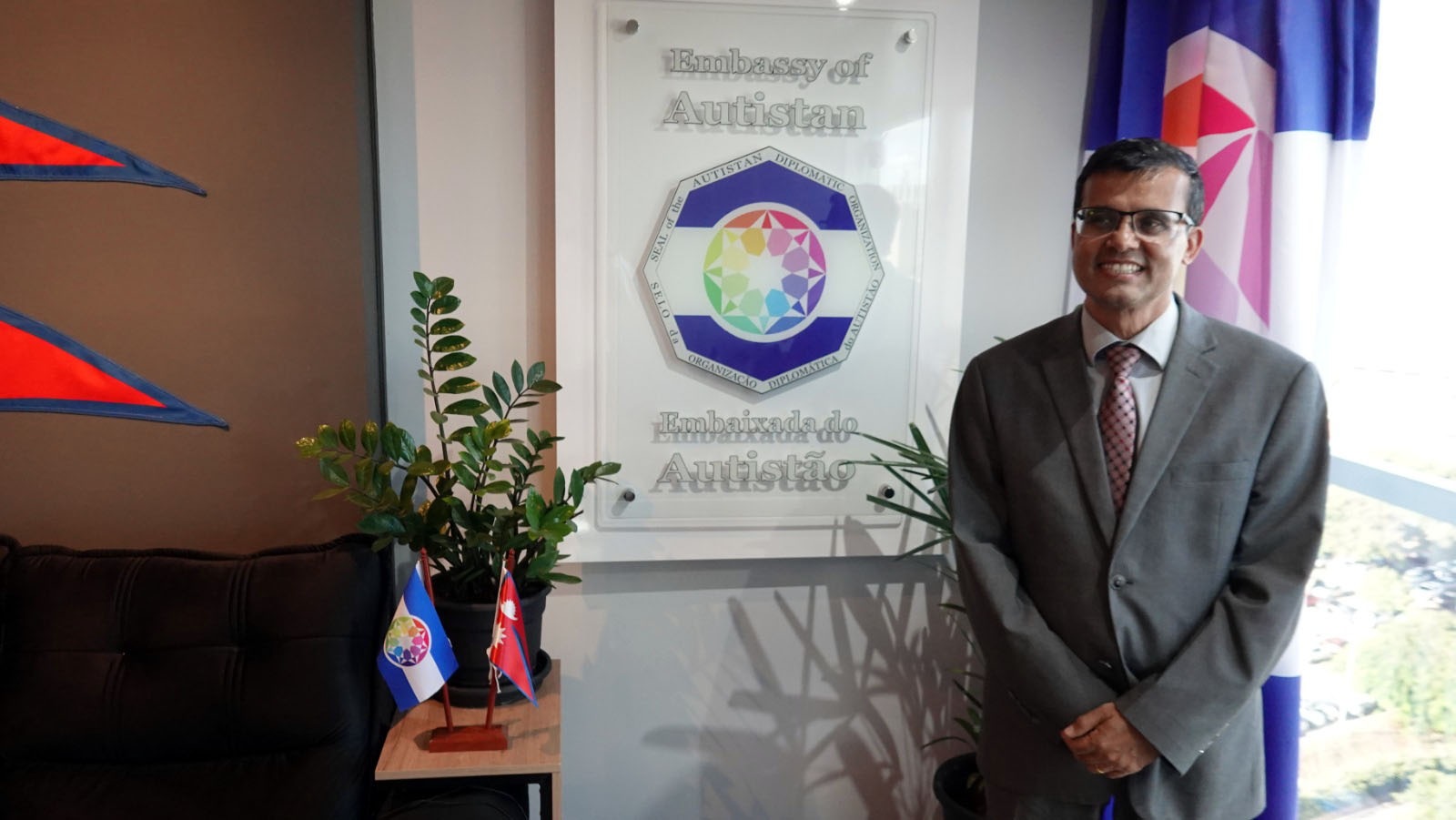
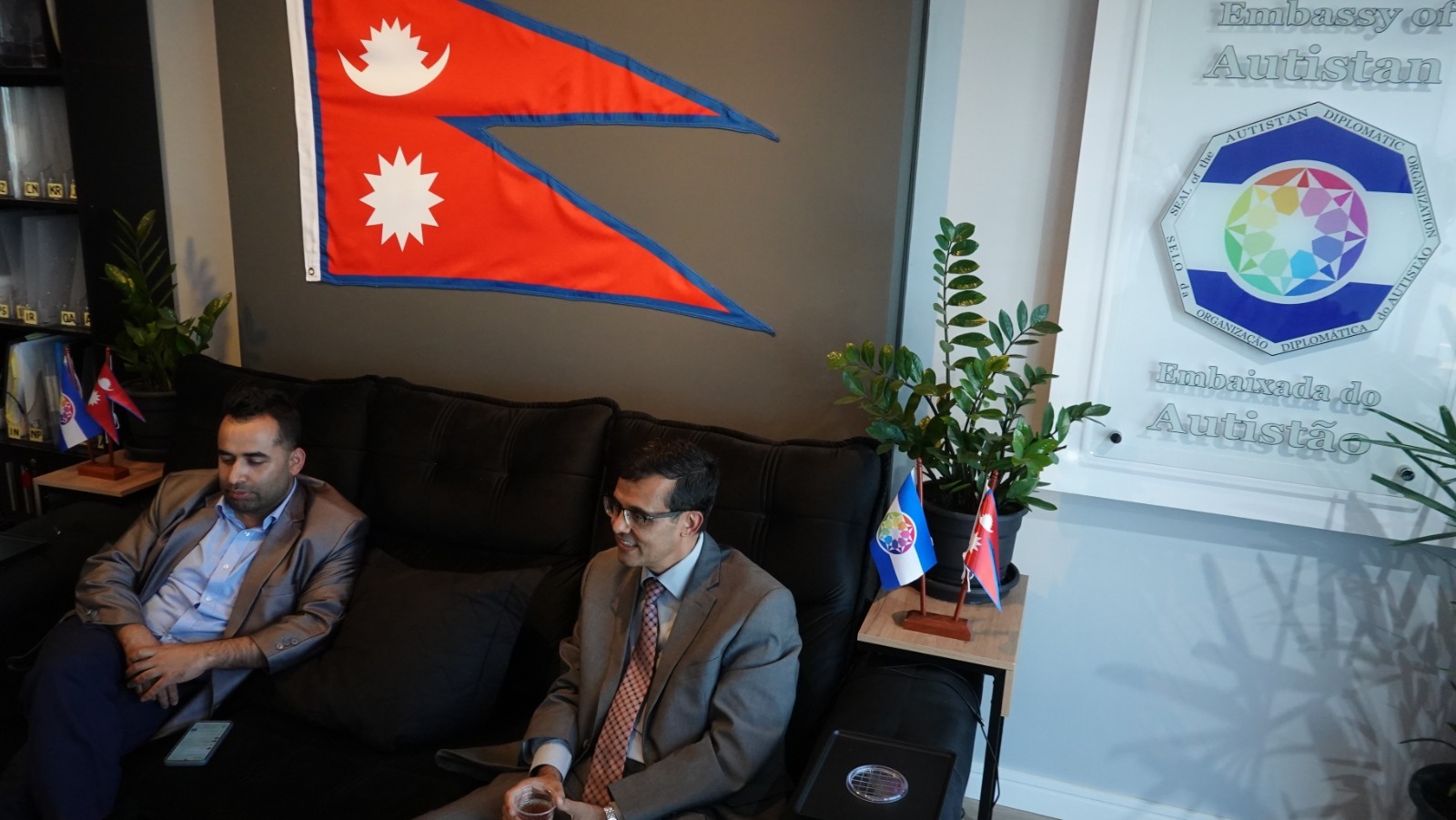
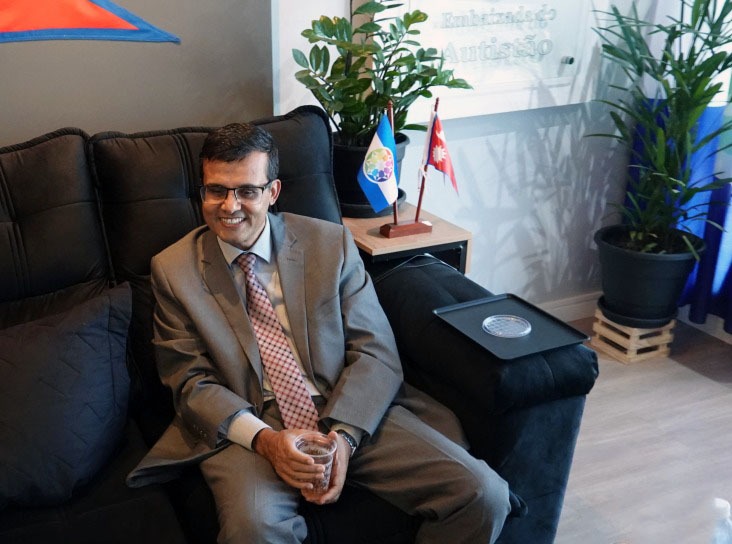
 Brasilia, 26 May 2026. The Embassy of Autistan in Brasilia had the honor of receiving Son Excellence Nirmal Raj Kafle, Nepal ambassador to Brazil, accompanied by M. Tejendra Regmi, diplomat atEmbassy of Nepal in Brasília, for a detailed presentation of the non-defectological approach toDiplomatic organization of Autistan regarding theautism, and for a possible future dialogue with the competent authorities in Nepal.
This visit had particular importance for the Autistan Diplomatic Organization, who had long wanted to receive representatives of the Embassy of Nepal at the Embassy of Autistan in Brasília, in order to open a human dialogue, institutional and useful around autism, the real needs of autistic people, and the possible contribution of the Organization to the development of public policies relating to autism in Nepal.
One of the main ideas that the Autistan Diplomatic Organization tried to present during this meeting is that its approach can be particularly well adapted to the realities and specific qualities of Nepal.. Many Nepalese families may have limited financial or material resources., and access to specialized urban services can be difficult, expensive or tiring due to distances, roads and transport. For this reason, it would be particularly important not to lock autism policy into imported models, expensive, centralized or “turnkey”, requiring repeated travel, professionalized systems and attempts to make autistic people conform. The Organization tried to show a possible convergence between Nepal's human capital — kindness, patience, intelligence subtile, watch out for others, helpfulness and sensitivity — and an approach based on accessibility, social adaptation, correct understanding and reduction of attitudinal barriers, rather than money, the strength, institutional power or standardization.
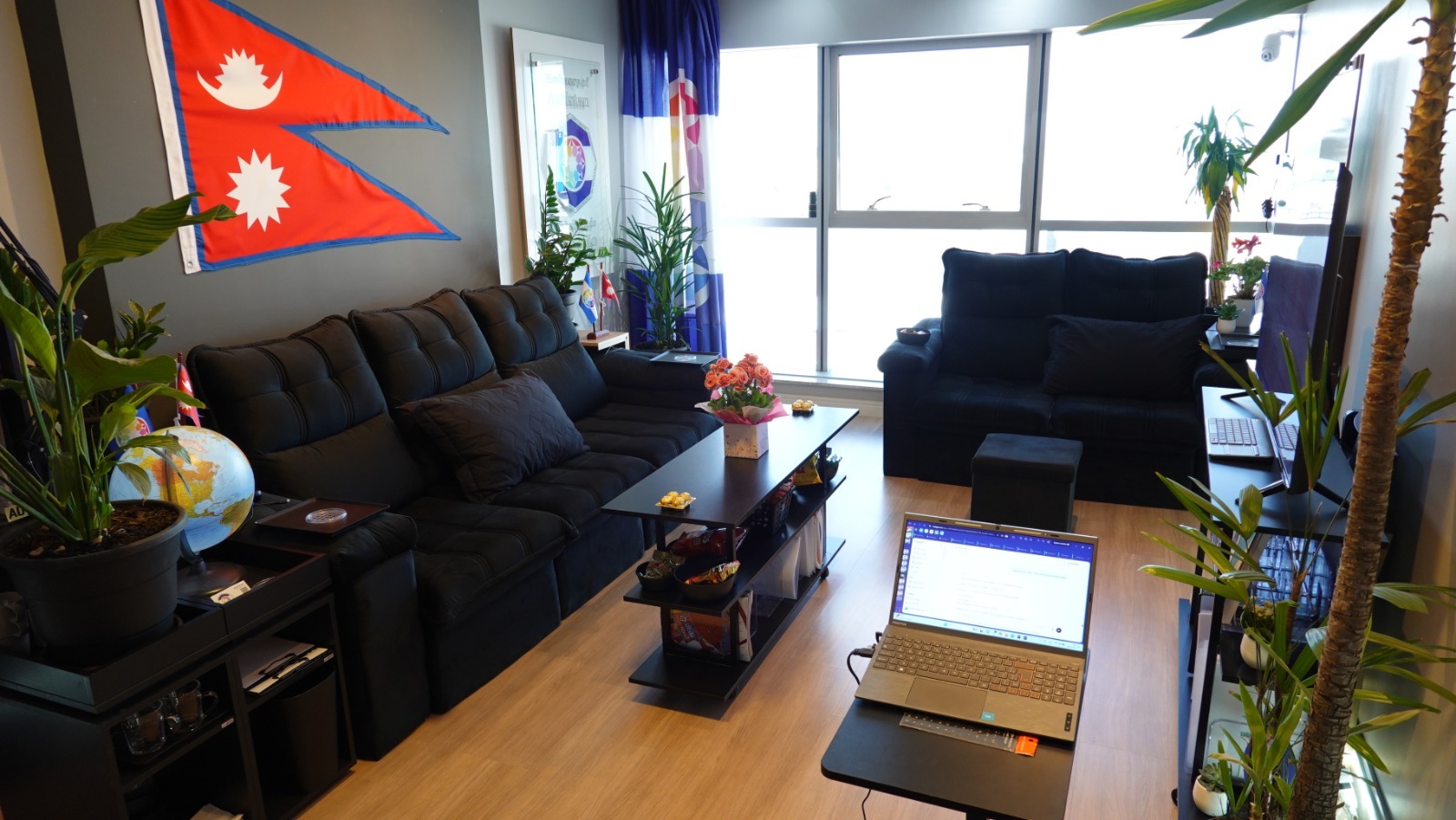
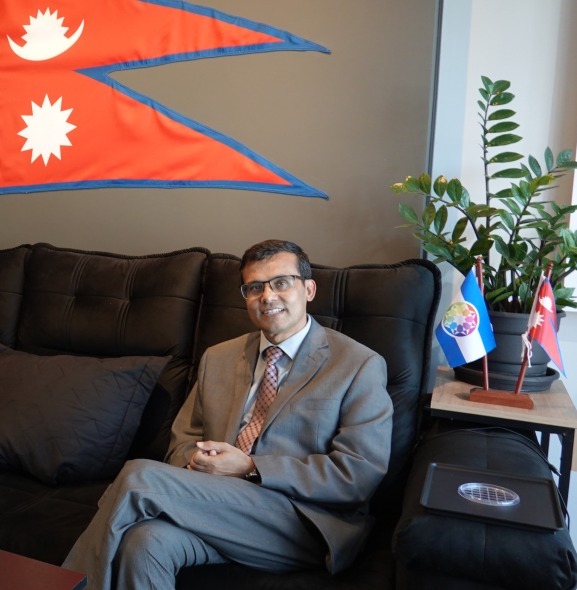
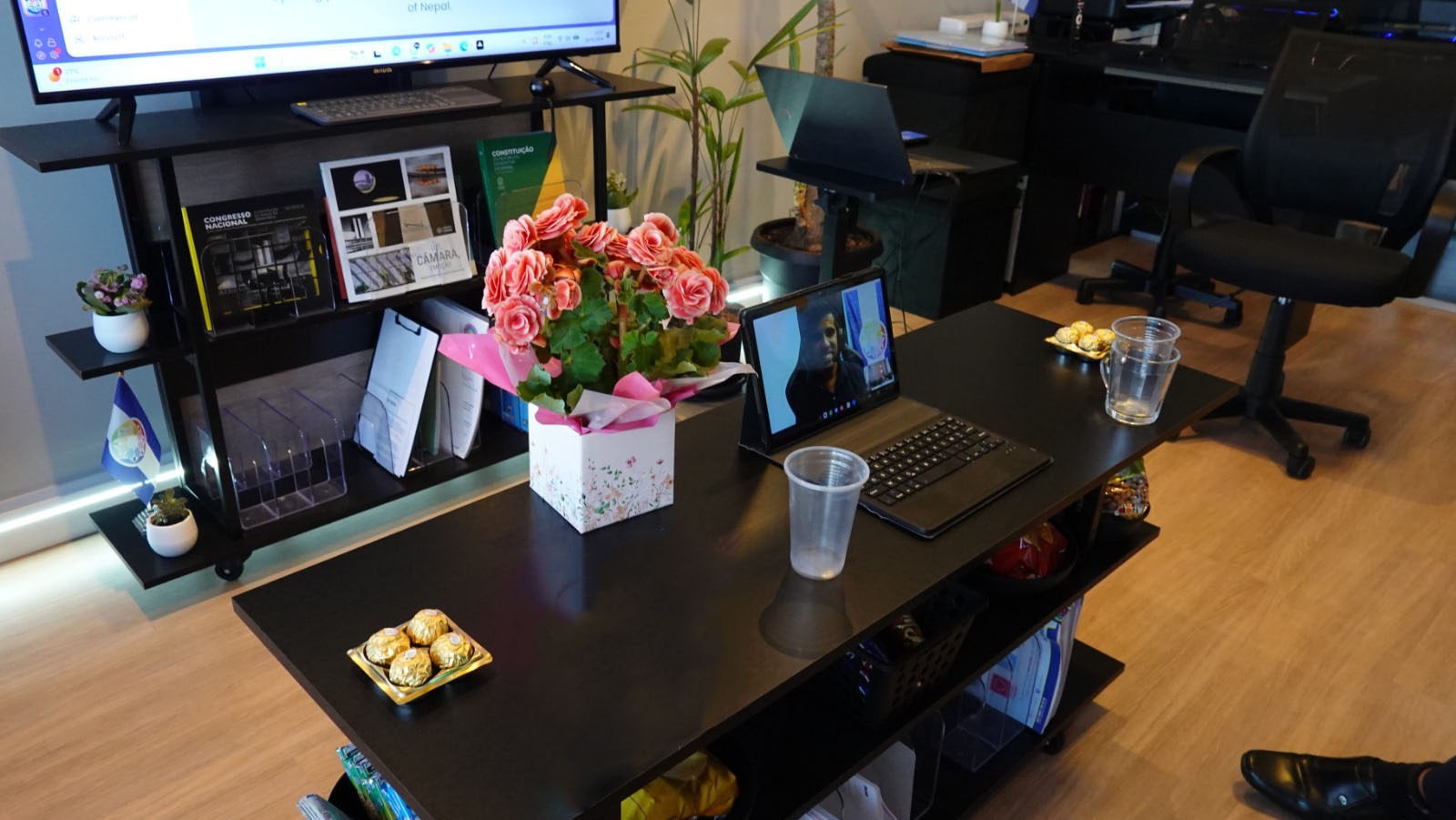
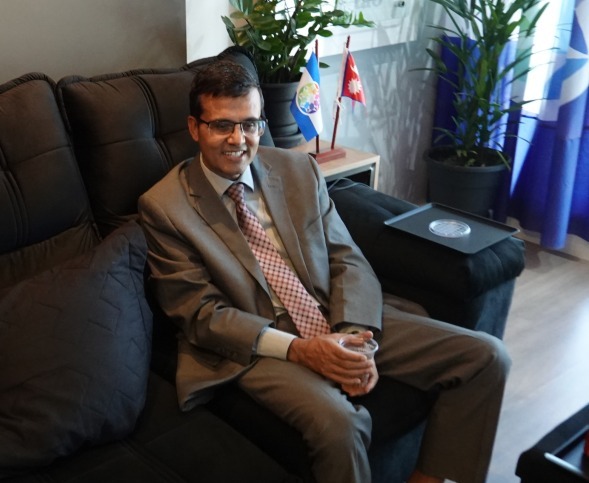
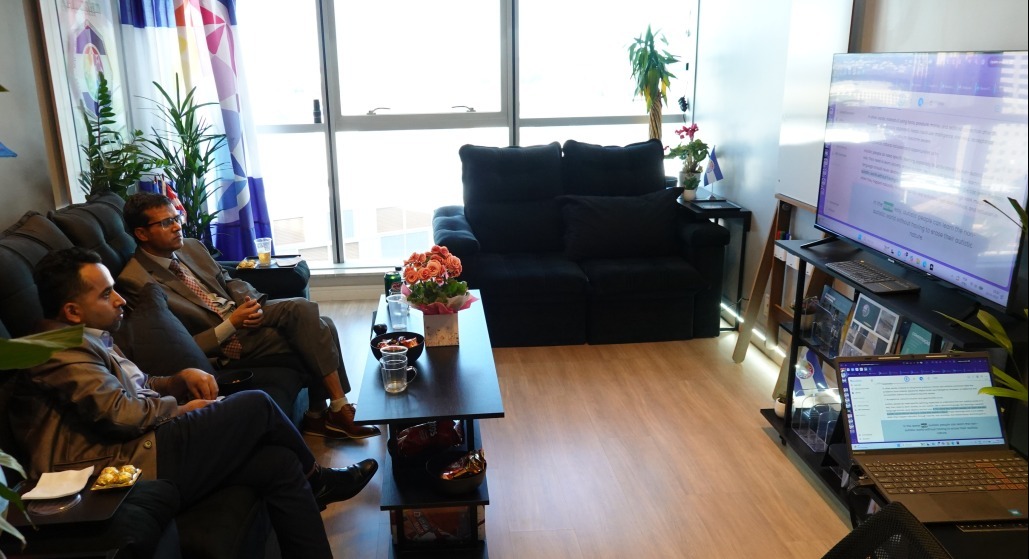
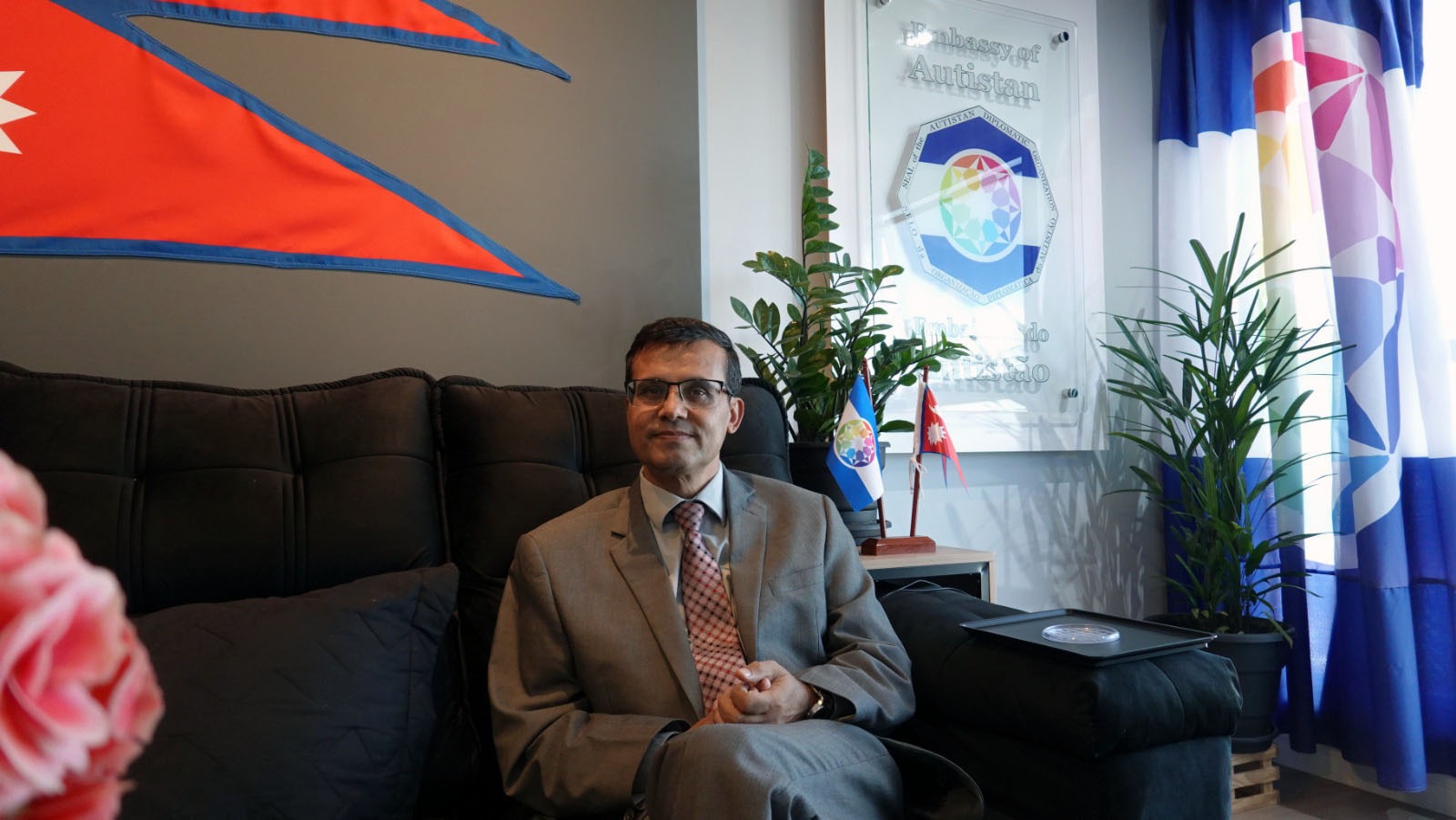
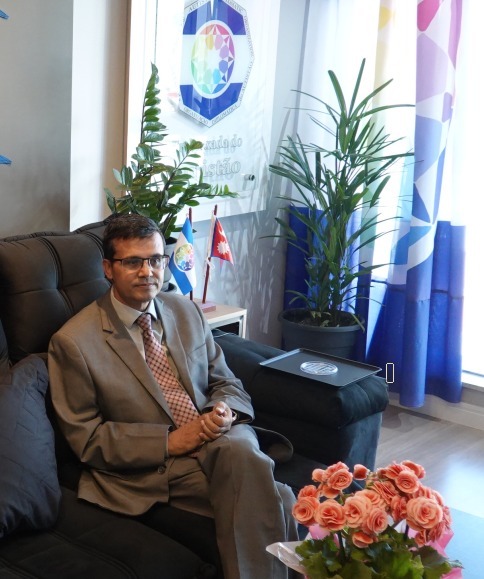
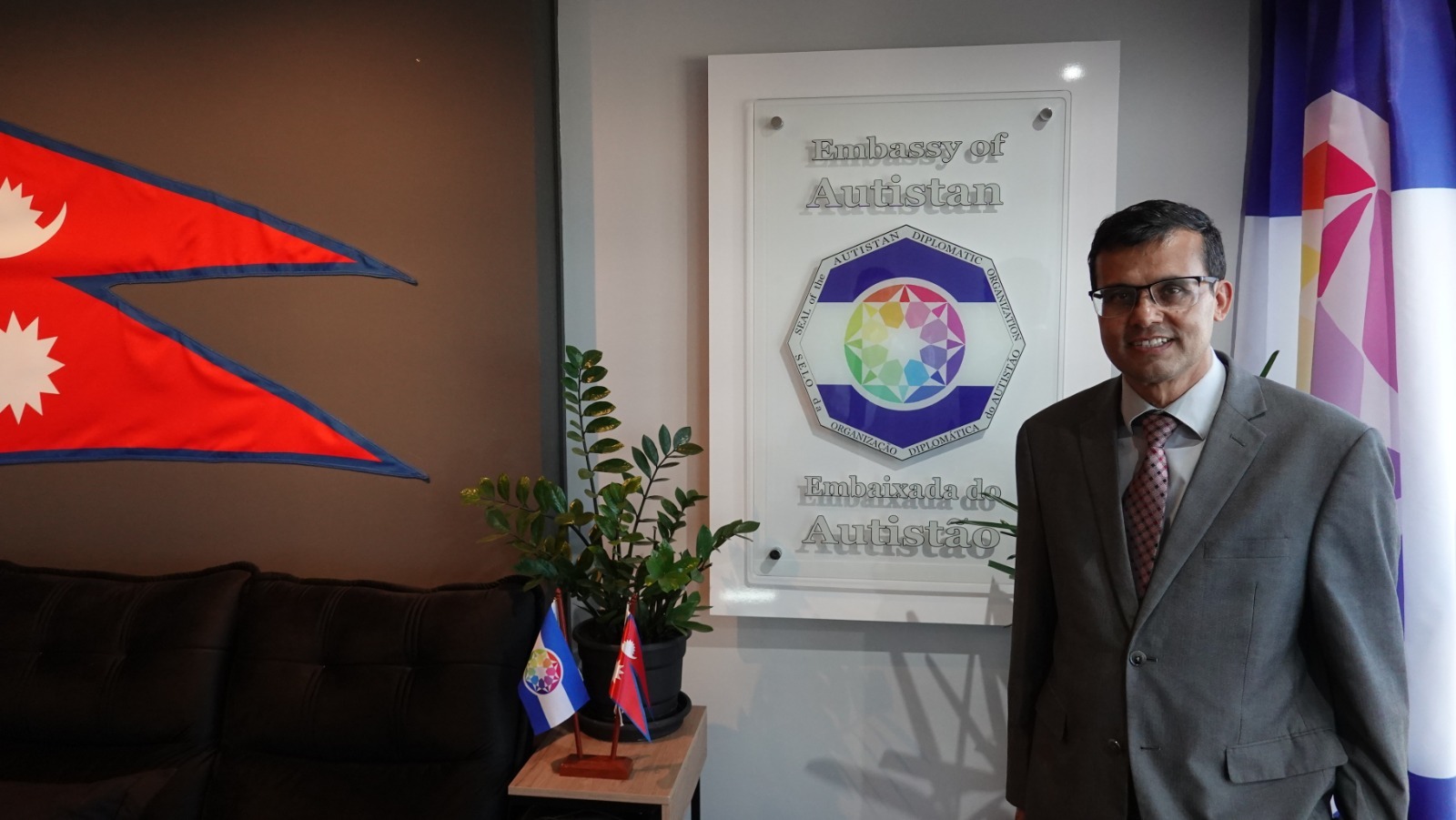
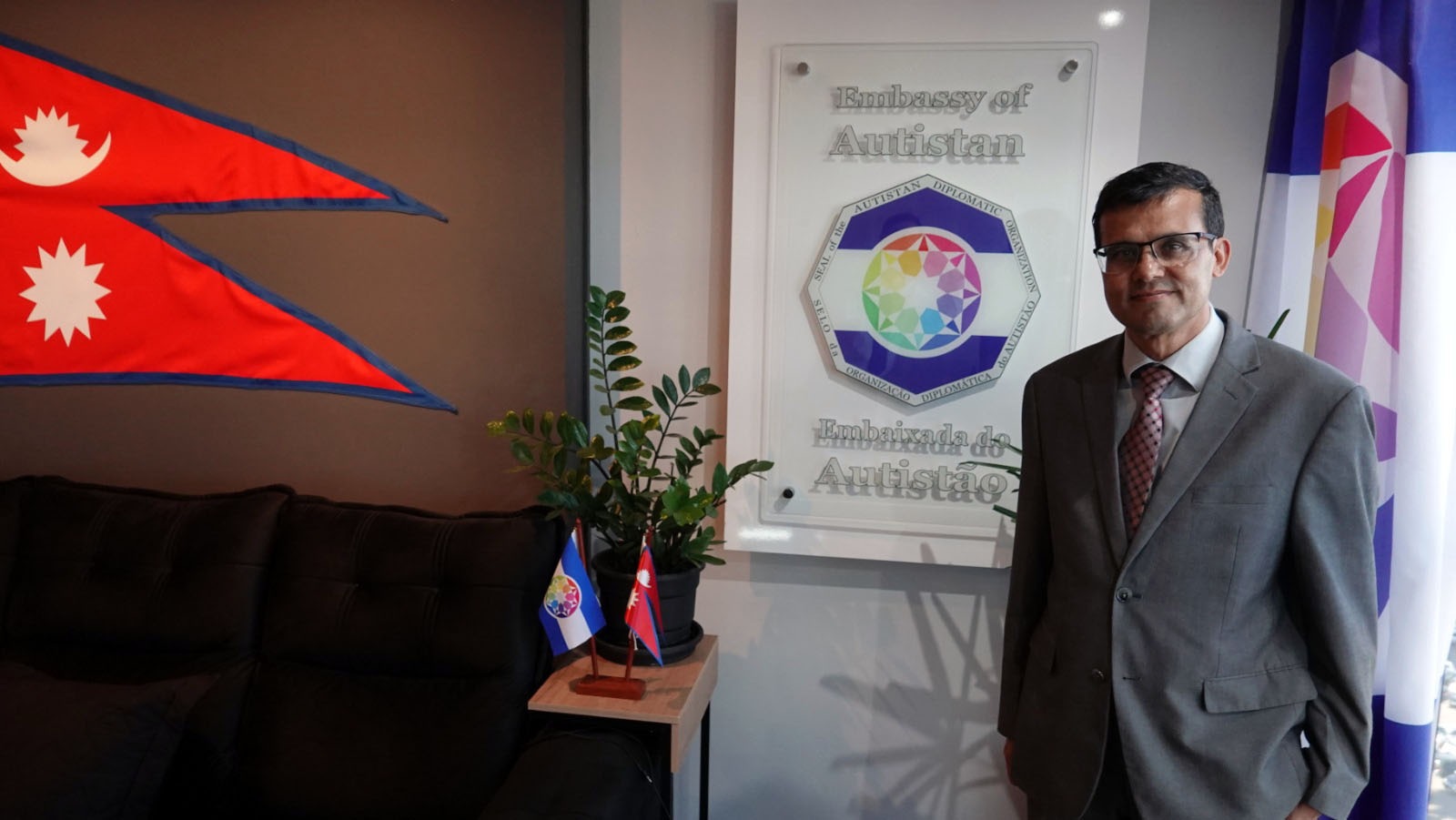
The meeting took place at the Autistan Embassy in Brasília, in a reception area specially prepared for this visit, with the presence of the flag of Nepal, of the plate of theEmbassy of Autistan / Autistan Embassy, small table flags from Autistan and Nepal, as well as an on-screen presentation device.
1. A first official visit in a symbolic and human setting
The location of the Embassy of Autistan in Brasília, close to ministries, of National Congress and other Brazilian public institutions, corresponds to the vocation of the Diplomatic Organization of Autistan : develop a dialogue with public authorities and institutions, in order to provide explanations, precise analyzes and proposals concerning autism and the real needs of autistic people.
The welcome was prepared in a spirit that was both diplomatic and human., in order to create real human contact at the same time as a formal meeting.
Before the main presentation, there was also a brief remote dialogue with M. Shree Ram Dangal, who intervened from Nepal. He greeted the Ambassador and the participants, and expressed his encouragement for the meeting. The representative of the Autistan Diplomatic Organization recalled the importance of Shree Ram in the journey that made this relationship with Nepal possible, and thanked him warmly.
2. A presentation prepared for the Ambassador of Nepal
The representative of the Autistan Diplomatic Organization had prepared a presentation specially intended for His Excellency the Ambassador of Nepal. This presentation was titled :
Opening presentation to His Excellency the Ambassador of Nepal — Embassy of Autistan in Brasília — 26 May 2026
Listen to the presentation
 Loading...

 Reload document
  Open in new tab
The presentation was prepared in the form of text read aloud and displayed on screen. Its aim was to explain why Nepal may have a special opportunity regarding autism, and how the Nepalese Embassy could help create a useful and concrete dialogue with the relevant authorities in Kathmandu.
The Organization clarified that it was not asking the Nepalese Embassy to become an autism specialist. Rather, she hoped that the Embassy could play the role of a human and institutional bridge, helping Nepalese authorities understand that a dialogue with the Autistan Diplomatic Organization could be useful for their own work.
3. Why the current moment may be important for Nepal
The Autistan Diplomatic Organization explained that the moment seems particularly important because Nepal seems to be in a phase of preparing texts, structures and projects related to autism.
According to public information found before the meeting, a project of National Autism Guideline appears to have been prepared or submitted to Ministry of Health and Population of Nepal. It was also mentioned that the government had announced autism-related model schools in all seven provinces, and that a technical committee would have been formed to work on the concept and structure of these schools.
These elements suggest that Nepal is not just at an abstract or theoretical stage. Texts, structures and models appear to be in preparation or under discussion. This makes the moment particularly important, because the first concepts, the first words and the first practical choices can guide an entire public policy for many years.
If the initial framework reduces autism to disorders, to treatments, to specialized services or standardization, it can then become much more difficult to correct this orientation. But if the initial framework is based on accessibility, the correct consideration of autism, acceptance of autistic people and autism itself, as well as respect for autistic nature, then Nepal could build its autism policy on fairer foundations, simpler, more humane and more useful.
This is why the Autistan Diplomatic Organization considered it important to present its approach at this stage., before the main directions become too fixed.
This question is not just conceptual. It is also practical for Nepalese families. If the first orientation favors expensive specialized approaches concentrated in cities, many families may remain unable to use them in real life, because of the cost, from the distance, roads, transport and time. A policy based primarily on accessibility, attitudinal changes, local understanding and simple, inexpensive adjustments could be much more accessible in daily life.
4. The fundamental distinction between autism and ASD
The first central conceptual point presented to the Ambassador was the distinction between autism itself et disorders or difficulties specific to autism, often called ASD.
The Organization explained that almost everywhere, the words “autism” and “ASD” are used as if they mean the same thing. This confusion has very serious consequences. If autism itself is reduced to disorders, then autism is automatically treated as a defect, an illness, a deficiency or inferiority.
This confusion also makes it incoherent to speak of “autistic qualities”. If autism was just a disorder, then talking about the qualities of autism would amount to talking about the qualities of a disorder, which doesn't make sense. But autistic qualities exist. This shows that autism itself cannot be reduced to a disorder, to a pathology or defect.
The Organization insisted that this distinction does not deny the existence of difficulties. Autistic people may have real support needs, real learning needs and sometimes significant difficulties. But these difficulties should not be confused with autism itself.
In other words, the existence of difficulties specific to autism does not justify describing the whole autistic nature as a disorder. The difficulty, the need for support or the disabling situation is not the same as autism itself.
The Organization also mentioned that this distinction was explained in 2023 to Chiara Servili, autism specialist at the headquarters of theWorld Health Organization in Geneva, during a long videoconference meeting. According to the Organization, she understood this distinction and recognized its usefulness.
During the meeting, The Ambassador reacted positively to this point and identified the distinction between autism and ASD as one of the important elements that had helped him better understand the subject.
5. The main conceptual position presented by the Autistan Diplomatic Organization
The main conceptual position presented by the Autistan Diplomatic Organization was as follows: :
Autistic people do not suffer from autism. Autistic people suffer the consequences of the lack of proper consideration of autism throughout the social system, and these consequences are socio-generated attacks, sensory, mental or other, at the end of the day, are violations of natural harmony.
This position means that the problem is not located only “inside” the autistic person. It is also found in the environment, in attitudes, in communication, in the organization, in social expectations, in the imposed rhythms, in relationships, and in the absence of natural and respectful opportunities.
In this perspective, accessibility is not a luxury, a secondary matter or privilege. It is the direct response to much of the suffering experienced by autistic people..
The Organization explained that many difficulties are increased, created or maintained by the way the social system is organized : incomprehension, fear, rejection, excessive complexity, sensory assault, inconsistent expectations and automatic attempts to normalize autistic people.
She also explained that some autistic reactions can be understood as signals. When an autistic person suffers, block, withdraws or reacts strongly, the correct response should not just be to silence the reaction, to correct the person, or to make the autistic person seem more normal. We must also ask ourselves what, in the environment, la communication, l’attitude, organizing or waiting, produces socio-generated harm, sensory, mental or other.
The image used during the presentation was that of an alarm. If an alarm sounds, the smart response is not to silence the alarm or unplug the siren. The intelligent response is to find out what danger, what inconsistency or aggression activated it.
Autistic reactions can therefore help reveal defects in the social system. Good autism policy should not just start with asking how to correct autistic people. It should also ask how society can become accessible enough for autistic people to live, learn, participate, develop and express their autistic qualities without being damaged.
6. A model based on accessibility, accommodations, individualized assistance and support
The Autistan Diplomatic Organization presented a model based on several levels, from the most general to the most individualized.
The first level is general accessibility for autistic people, based as much as possible on the universal design. The company, services, the procedures, communication and attitudes should be made generally accessible before an autistic person is already in difficulty.
The second level is that of reasonable accommodations in the presence of autism. When general accessibility is not enough for a particular situation or person, specific adjustments must be identified, implemented, checked and corrected if necessary.
The third level is that of general assistance in autism, accessible as much as possible, including remotely. This assistance could be useful not only for autistic people and their families, but also for schools, public services, the professionals, emergency services, workplaces, businesses and ordinary contexts faced with situations involving autism.
Such assistance could also use digital tools and artificial intelligence to link practical guidance, education, the statistics, recurring problems and possible solutions. The idea is not to replace human responsibility, but to make guidance more accessible and more useful in ordinary situations where people do not know how to react to difficulties linked to autism.
The fourth level is that of individualized support for autism, for autistic people and families who need more specific support, personal and ongoing.
The logic is not to start with individualized systems that are expensive for everyone. The logic is that of subsidiarity : firstly make society generally more accessible, then add reasonable accommodations when necessary, then provide general autism assistance for many situations, and finally provide individualized support for those who need it.
This approach may be particularly relevant for a country where resources, specialists and access to urban services may be limited. She does not deny the usefulness of specialized support, but it avoids making specialized and individualized systems the only possible response.
It also avoids placing all the burden on families who may not have the money., the time or transport capacity needed to repeatedly access specialized urban services. The first response should therefore not be an expensive system accessible only to a minority, but a large correction of the environments, ordinary attitudes and situations where autistic people actually live.
7. Attitudinal accessibility : one of the most decisive dimensions
An important part of the presentation concerned attitudinal accessibility.
The obstacles encountered by autistic people are not only sensory or material. They are also found in attitudes : fear, judgement, rejection, misinterpretations, ego reactions, misunderstanding of autistic behaviors, automatic normalization attempts, mockery and exclusion.
Families, schools, public services and communities can avoid a lot of problems if they receive simple and correct guidance. Much of the conflict, exclusions, suffering and costly interventions can be reduced if the social environment learns not to judge, not to reject, and understand situations involving autism.
The Organization insisted that accessibility for autistic people is not a privilege taken away from others and given to autistic people.. It is a correction of the social system itself. Very often, these fixes are useful for everyone, because they reduce confusion, aggression, the inconsistency, the excess, disorder and unnecessary complexity.
Autistic people are often the first to suffer from these defects of the social system, but when these defects are corrected, the whole society can become clearer, calmer, more consistent, more economical and more humane.
This is one of the reasons why the Organization considered its approach particularly relevant for Nepal.. Attitudinal accessibility does not primarily require expensive buildings, imported programs or heavy centralized structures. It requires correct information, attention, patience, a desire to adjust, and the ability not to interpret autistic reactions through fear, ego or rejection.
8. Why this approach can be particularly adapted to the human qualities and realities of Nepal
The organization explained that many autism policies in richer countries rely on expensive systems, centralized, professionalized and urban. These models often require travel to cities, repeated interventions, specialized programs, professional control and significant family resources. Some also remain oriented, explicitly or implicitly, towards making autistic people seem less autistic.
For many families in Nepal, such models can be very difficult to use in real life. Financial resources may be limited, and access to specialized urban services can be difficult, expensive and tiring due to distances, roads, transport and time. If autism policy is built mainly on expensive centers, repeated trips and specialized professional systems, many families may receive a formal policy on paper but little practical help in daily life.
Such models can also become abusive when they mainly aim to normalize autistic people instead of respecting autistic nature.. They often rely on money, institutional power, professional authority and the idea that autistic people should be made to conform to non-autistic expectations. This is precisely the type of logic that the Autistan Diplomatic Organization is trying to avoid..
The Autistan Diplomatic Organization therefore tried to present another possibility for Nepal : not a weak or minimal policy, but another type of politics, based primarily on intelligence, discernment, humanity, kindness, accessibility, acceptance, social adaptation and respect for autistic nature.
The representative of the Organization referred to his personal experience with Nepalese people and his stay in Nepal. He explained that he often observed qualities such as kindness, humility, patience, the desire to help, attention to others, the delicacy, and a lesser tendency to get offended or react with the ego. He clarified that, Of course, not all Nepalis are the same, but that this human potential can be very important for autism.
For autistic, such qualities are not secondary. Patience, humility, kindness, sensitive attention to others and the ability not to take autistic reactions personally can make a huge difference. In autism, human capital can solve problems that money alone cannot solve.
This is where a particularly important convergence may exist between Nepal and the approach proposed by the Autistan Diplomatic Organization.. The Organization's approach is not based on force, money, heavy systems, coercion or trying to make autistic people conform through pressure. It is mainly based on accessibility, correct understanding, social adaptation, reducing attitudinal barriers, and creating conditions in which autistic people can learn, participate and develop without being damaged or forced to erase their autistic nature.
This seems particularly relevant for Nepal. On one side, many families may not have the financial or material means to rely on expensive systems, frequent travel, specialized urban services or imported “turnkey” methods. On the other side, Nepal may already have, in its social and human qualities, many of the provisions necessary for a more accessible approach, more respectful and more natural : kindness, patience, helpfulness, subtlety, humility, delicacy and capacity for human attention.
Because the Organization’s approach gives great importance to attitudinal accessibility, these qualities can be decisive. Attitudinal barriers often appear when people judge, reject, make fun, are afraid, misinterpret or take personally the reactions of autistic people. If a society can receive simple and correct information about autism, and if people are already relatively willing to be patient, to kindness, helpfulness and non-aggressive attitudes, then many obstacles can be reduced without huge financial expenditure.
This is why the Organization considered that Nepal may have all the necessary dispositions and qualities to make good use of this alternative approach.. It would seem regrettable to try to apply, without deep adaptation, ready-made methods imported from rich Western countries : often expensive methods, difficult to access, sometimes harmful, not always very effective, and frequently based on making autistic people conform. Nepal could instead build on what it already has : human attention, patience, social subtlety, practical adaptation, community life, and possibility of doing useful things with limited material means.
In this sense, Nepal's main capital in this area may not be financial capital, but human capital. This human capital could allow Nepal to develop a more accessible model, less expensive, less violent, less normalizing and more consistent with the real needs of autistic people.
This does not mean that specialist support, professionals or structured services are useless. They may be necessary. But they should not be the sole basis of politics, and they should not replace a broader effort to make families, schools, public services and communities more accessible to autistic people.
The Organization also mentioned the symbolic originality of Nepal : its unique flag, their particular time zone, its geography and cultural identity. It would be regrettable, and almost absurd, that such an original country simply imports a normalizing model whose aim is precisely to make autistic people appear less different.
Nepal could, on the contrary, develop a Nepalese model for autism, adapted to its own realities, to families with limited material means, and potentially useful for many other non-rich countries. Such a model could show that a country does not need to copy expensive and sometimes questionable approaches to helping autistic people.. He can use accessibility, human quality, correct understanding, inexpensive adaptations and respect for autistic nature as stronger foundations.
9. Learn non-autism like a second language, without deleting the first
Another important idea presented during the visit was that autistic people do need to learn certain things to understand non-autistic society., avoid certain dangers, participate in social life and be better understood.
The Organization has been very clear that it is not denying the need for learning. Autistic people may need specific learning about society, la communication, ordinary expectations, the dangers, practical life and the non-autistic world.
However, this learning should not mean the erasure of autism.
The Organization used a comparison with languages. A French person living in Brazil must learn Portuguese and certain Brazilian cultural codes. But learning Portuguese does not require eliminating the French language, French culture or personal history. In the same way, autistic people can learn the non-autistic world as a sort of second language, without destroying their first autistic language.
This comparison is important because it avoids a false opposition. The point is not to refuse learning, and it is not to leave autistic people without tools. The point is to distinguish useful learning from normalization that seeks to suppress the autistic nature.
Autistic people should be helped to understand the non-autistic world, but without being forced to erase their autistic way of being, their autistic qualities, their originality, their specific interests, their sensory needs, their forms of attention and their relationship to the world.
10. Acceptance is not passive tolerance
The Organization also explained that acceptance should not be passive, superficial or condescending. It is not enough to say that autistic people are tolerated. Real acceptance means allowing autistic people to exist, to learn, to participate and develop without being forced to appear non-autistic.
Acceptance does not mean refusing all learning. It does not mean ignoring difficulties. It does not mean abandoning autistic people without help. It means respecting autistic nature while meeting real support needs, to real difficulties and real situations of disadvantage.
If autism itself is accepted, a lot of effort currently spent to make autistic people appear not autistic becomes useless, or even clearly harmful. Energy can then be used to make society more accessible, support useful learning and create real opportunities for participation.
11. Natural inclusion and opportunities to try
Inclusion was presented not only as a right, but also as a natural learning environment, provided that the people around are sufficiently accessible.
The Organization stressed the importance of providing opportunities instead of overprotecting. Many autistic children are considered incapable simply because they are autistic, or because autism is interpreted as a global disability. This perception often prevents them from receiving real, safe and respectful opportunities to try, to participate and learn.
This point must be distinguished from another : autistic people are often placed in disabling situations because of socio-generated obstacles in the environment. The first problem is the perception of incapacity imposed on autistic people because they are autistic. The second problem is the production of incapacitating situations by an inaccessible social environment.. Both problems exist, but they should not be confused.
The Organization gave the example of Tima, a young autistic boy in Kazakhstan (Autistan.kz). In a natural mountain environment, with a non-defectological approach, it was not treated as diseased or defective. He received concrete opportunities through simple tasks and real activities.
At first, he seemed very passive and almost disconnected from activities. His family, probably with good intentions, seemed to feel that he would never really be able to do anything for himself because he was autistic. The answer was not to force it through an expensive specialized program, but to give him real opportunities, simple and respectful to participate.
In just a few days, his attitude has visibly changed. He gained confidence, participated in practical activities, been recognized by other children and experienced simple moments of friendship. The Organization explained that photos and videos can show this evolution.
The main point was not expensive therapy. The essential point was a natural environment, respectful, non-defectological, and a concrete change in the system around autistic children.
12. An autistic free life, sustainable and accomplished
The presentation also discussed the idea of a free autistic life, sustainable and accomplished.
An autism policy should not stop at childhood, au diagnostic, at school or health. She should consider the whole life of autistic people : identification or confirmation of autism, integral health, autism friendly education, vocational training, independent living possible, autonomy, continuity of support, aging and longevity.
It should also protect the possibility of a fulfilled autistic life : creativity, specific interests, nature, experiences, discoveries, voyages, chosen relationships, freedom, originality and personal journey.
A very important part of this approach is the valuation, protection and application of autistic forces. This means changing the frame. Some apparent defects may actually reveal autistic strengths, and certain autistic reactions may function as signals showing where the environment produces sociogenerated harm, sensory, mental or other.
Instead of only seeing apparent defects, public policy should also recognize autistic strengths. Autistic reactions can help identify harmful features of the social system and help society return to greater balance and harmony..
13. A spontaneous synthesis after the prepared presentation
After the prepared presentation, the representative of the Autistan Diplomatic Organization added a spontaneous summary of the main message he had tried to convey.
He explained that instead of importing the usual approaches to autism — often medical, technological, expensive, centralized, based on specialized centers and difficult to access for many families due to the cost, distance and transport — Nepal could also consider a complementary and alternative approach, based on accessibility, in particular attitudinal accessibility.
Autistic people actually need to learn about society : how to understand social situations, how to behave in certain contexts, how to avoid dangers and how to participate more easily in ordinary life. But this learning should not mean the suppression of autism. Autism is a difference. It includes both strengths and difficulties, and it should not be reduced to a defect that should be eliminated.
To explain this, he used a comparison with languages. A French person living in Brazil must learn Portuguese and certain Brazilian cultural habits. But learning Portuguese does not require erasing the French language, French culture or personal French experience. In the same way, autistic people can learn the non-autistic world as a sort of second language, without destroying their first autistic language.
He then explained that, in many countries, the first reaction of families and systems is to see the most superficial and problematic aspects of autism, and fear that the autistic child will suffer later because people will reject him, will make fun of him or exclude him. This fear can lead parents to think that the only solution is to correct or normalize the child.
But there is another way : autistic people can learn useful things, while society can also learn not to judge them, not to reject them and not to make fun of them.
This second dimension is extremely important because it can be very useful, very effective and very inexpensive. It is mainly about awareness, correct information and attitudes. Autistic people can't actually be transformed into non-autistic people. Therefore, instead of trying to erase autism, it is much more coherent to make society more accessible and more welcoming, while helping autistic people learn what is useful for living in society.
This is why this approach may have particular meaning for Nepal. Many common methods are expensive, not always very effective, and sometimes mistreating autistic people because they are based on normalization. In Nepal, However, there seems to be another type of capital : human capital.
The representative of the Organization spoke of what he perceived as kindness, patience, humility, helpfulness and an ability not to get offended easily. He mentioned his own experience with Shree Ram Dangal, who lived with him for several years and never reacted with offense, even in difficult times.
He also recalled that, during his stay in Nepal, he had not observed the same type of aggressive or judgmental social reactions that often create barriers for autistic people. For this reason, he considered that Nepal may have strong social potential for attitudinal accessibility.
The Government of Nepal can continue to develop centers, medical or specialized services and approaches. But a complementary approach could be added : inform the company, families, schools, public officials and communities so that autistic people are better accepted, less judged, less rejected and better understood.
Such an approach would cost much less than heavy specialized systems, and could help reduce suffering, exclusions, unnecessary conflicts, hospitalizations and other serious consequences.
The main point was therefore that, if society remains inaccessible and hostile, families may feel pressured to normalize autistic children because they fear the system will harm or exclude them. But if the social system becomes friendlier, better informed and more accessible, then autistic children can learn what they need to learn while retaining their autistic qualities and autistic nature.
For the Diplomatic Organization of Autistan, this makes the Nepalese context particularly significant : Nepal may have human qualities particularly useful for autism, and these qualities can be more effective than expensive methods when combined with correct information, awareness and practical accessibility.
14. The Ambassador's reaction : acceptance, dignity, respect and environment
After the presentation, His Excellency the Ambassador of Nepal thanked the Organization and indicated that the presentation had helped him better understand the subject.
He identified two important messages in what had been presented.
The first concerned the view of autistic people and the importance of acceptance. The Ambassador stressed that it is not just about accepting autistic people, but also to recognize the dignity and respect to which they are entitled.
The second concerned the importance of the environment. He stressed the need to consider the environment and inclusion. This allowed the Organization to clarify again that obstacles can be sensory, but also attitudinal, and that attitudinal barriers are often forgotten.
This reaction was important because it showed that the Ambassador had clearly perceived two central axes of the approach : change the way we look at autism, and adapt the social system instead of just trying to correct autistic people.
15. Specialized schools or inclusion ?
An important discussion then took place about autism-related schools that could be developed in Nepal.
The Ambassador indicated that he was not fully informed about everything that is currently being done in Nepal in the field of autism, but that he had read or heard that the government was considering opening schools for autistic children.
He then asked a very important question : is it better to open new specific schools for autistic children, or integrate them into mainstream schools ?
The Organization responded that this question goes directly to the heart of the problem. The main challenge for autistic children is learning to live with others. If they are placed only in schools with autistic children or children with similar difficulties, with only specialized personnel, they cannot learn ordinary social life naturally.
This does not mean inclusion is easy, nor that no adaptation is necessary. But when a few different children are included in ordinary environments, with minimal preparation of the environment and attitudes, they can learn about real society instead of being separated from it.
The Organization also referred to its own experience of being placed in a specialized center at the age of six or seven.. Such a context can make the child think that he himself is “problematic” or “abnormal”, because he is placed among children who are all perceived to have problems.
This discussion was important because it connected the Nepalese political context to a broader issue : how can autistic children learn society if they are separated from society ?
16. The possible contribution of autistic people to society
The Ambassador then developed the idea that autistic children can be integrated into society and contribute to it..
He explained that every autistic child may have a particular ability or aptitude, and that it is important to help the child develop the skills that correspond to him, so that later the person can contribute to society through an occupation, a job or social activity.
He gave the example of Nepal concerning blind or visually impaired people. He mentioned that, in some public schools, there are opportunities for blind people to become teachers. He referred to the case of a blind cousin who became a teacher.
This comparison opened up the idea that there can also be autistic teachers., or more broadly autistic people playing useful professional roles in society.
The Organization nevertheless recalled that one of the major obstacles remains rejection. People who appear strange or different are often automatically rejected because they are scary or because they do not fit into normal social expectations..
The Ambassador recognized the importance of this problem and compared it to other historical social changes. He recalled that changes that seemed difficult in the past, for example regarding the participation of women in public life, finally took place quickly on a historical scale.
This part of the dialogue was important because it linked the issue of autism to a broader human and social issue : societies can change their perceptions of groups that were previously excluded, underestimated or considered incapable.
17. The role of the Embassy of Nepal as a human and institutional bridge
The Ambassador explained that the role of the Nepalese Embassy in Brasília is not only to maintain relations with the Brazilian government, but also with civil society, people, academic circles and institutions. He presented this as falling under the public diplomacy.
The Autistan Diplomatic Organization explained that this was precisely the type of role that could be very useful. A simple letter or email sent directly to an institution may receive a polite response and then go unanswered.. But if the Embassy of Nepal, after meeting the Organization, indicates to the competent authorities that this initiative seems serious and deserves attention, then officials in Nepal can take the approach much more seriously.
In this sense, the Embassy can help overcome the first attitudinal barrier : the initial doubt, lack of understanding, lack of time, lack of knowledge of the approach, or the impression that autism should be treated only by the usual medical or institutional frameworks.
The Organization explained that names and email addresses are useful, but often insufficient. What is most effective is a human and institutional connection that can lead to a real working relationship : first a short technical note, then a real videoconference, and later, if this is useful, a more precise contribution to documents or projects in preparation.
The Organization gave the example of previous dialogues with Jonas Ruskus, rapporteur for France UN Committee on the CRPD between 2019 et 2021. At first, the dialogues were polite and limited. But as the dialogue has developed, he understood more and more the importance and usefulness of the Organization’s explanations.
This example was used to explain that an unusual contribution may initially seem difficult to evaluate or secondary., but when a real dialogue can develop, competent people can gradually understand its usefulness for their own work.
18. A concrete sequel : documents, evidence and possible contacts in Nepal
The Ambassador proposed a concrete follow-up.
He asked the Organization to send, electronically, to the official email address of the Embassy of Nepal, the presentation used during the meeting, available resources, the videos, evidence of work already done with the United Nations, the World Health Organization, France and Kazakhstan, as well as useful documents, especially in PDF format.
He indicated that these elements could be studied by the Embassy and that after this first examination, the Organization could write again. The Embassy would then try to identify relevant contacts in Nepal, particularly among government institutions or institutions working in the field of autism.
The idea of a future videoconference was also discussed. The Organization explained that written documents are useful, but that a real dialogue by video often makes it possible to clarify difficult concepts and avoid misunderstandings.
The example of the meeting with Chiara Servili was mentioned again in this regard. At first, the distinction between autism and autism-specific disorders was not immediately obvious. But through dialogue, the questions, clarifications and examples, the meaning and usefulness of this distinction have become clearer.
19. National Autism Plans and the importance of implementation
The meeting also allowed a discussion on national autism plans in different countries..
The Organization indicated that in 2024 she had realized a study on the Australian draft national autism plan, with a comparison showing that approximately 18 countries or regions already had a plan at that time, a national autism strategy or document. It was also noted that there may be more today.
This comparison may be useful for Nepal, because a national autism policy is not just a question of general principles. It also requires implementation : priorities, measures, responsibilities, coordination, practical actions, accessibility, support systems and monitoring.
The example of Iran was briefly mentioned, following the recent visit of the Cultural Attaché of Iran (Autistan.ir) at the Autistan Embassy. The organization said Iran also appears to be working on a national document related to autism.
Brazil was also mentioned. The Organization explained that Brazil has many laws on autism, but still lacks a real national implementation plan.
A comparison was made with a large ship. If autism was a very big ship, families should not be left alone on board, without captain, unmanned, without staff and without practical organization, while only receiving hundreds or thousands of pages of maritime or navigation laws. Laws are important, but they do not replace a plan, structure and practical orientation.
Ambassador noted countries could learn from each other. This remark opened an important perspective : a future dialogue could not only be bilateral between Autistan and Nepal, but also comparative and international.
20. General appreciation of the visit
This visit can be considered very positive.
One of the most important significance of the visit was the clear convergence that the Autistan Diplomatic Organization tried to present between the concrete realities of Nepal, the human qualities of Nepal, and the non-defectological approach proposed by the Organization. This approach may be particularly relevant in a country where many families cannot easily rely on expensive specialized systems., repeated trips or urban services, and where human qualities such as patience, kindness, helpfulness, the delicacy, attention to others and social subtlety can become central resources for accessibility.
It made it possible to officially receive His Excellency the Ambassador of Nepal to Brazil at the Embassy of Autistan, with M. Tejendra Regmi, diplomat at the Embassy of Nepal in Brasília.
It also made it possible to clearly present the approach of the Autistan Diplomatic Organization, in particular the fundamental distinction between autism and autism-specific disorders, the importance of attitudinal accessibility, the need to reduce socio-generated harm, sensory, mental or other, and the possibility of thinking about autism policy in a way that is not centered on the defect, standardization or expensive specialized systems.
The meeting opened a serious discussion on the risks of approaches too focused on specialized frameworks or standardization, as well as the importance of inclusion, of dignity, respect and real opportunities for autistic children and adults.
It also showed that Nepal may have particular potential to develop a more humane approach to autism., less expensive and less standardizing, based on accessibility, acceptance, human qualities, natural inclusion, l’adaptation locale, less dependence on expensive travel or specialized centers, and respect for autistic nature.
The meeting confirmed the importance of human diplomacy and direct dialogue. The Organization was able to show that it does not seek to impose an external vision, but to offer explanations, analyses, useful experiences and contributions, in order to help the Nepalese authorities make fairer and more effective choices at a time when the first national guidelines concerning autism still seem to be under construction.
21. Conclusion
This first visit of the Ambassador of Nepal to Brazil to the Embassy of Autistan in Brasília marks an important step in the opening of a possible dialogue between the Diplomatic Organization of Autistan and the competent Nepalese authorities in the field of autism.
It made it possible to present an approach based not on the correction of autistic people, but on correcting the obstacles of the social system, accessibility, acceptance of autism, the dignity of autistic people, and the possibility of a free autistic life, respected and accomplished.
Nepal, by his human qualities, its cultural singularity, the limited material means of many families, the practical difficulty of relying primarily on expensive urban services, and the current preparation of structures or orientations related to autism, could have the opportunity to develop an original autism policy, useful and exemplary, adapted to its realities and potentially inspiring for other countries.
The Autistan Diplomatic Organization warmly thanks His Excellency the Ambassador of Nepal to Brazil and Mr.. Tejendra Regmi for their visit, listening to them, their patience and openness, and hopes that this first meeting can be followed by a concrete dialogue with the authorities and institutions concerned in Nepal.