

1. General presentation
Autistan Embassies represent Autistan to states or territories “official”, as well as with national and international organizations and authorities.
- They can be :
- 1.1.1. Local and material (i.e.. “Physical embassies”) :
A physical space in a country, used exclusively as an Embassy of Autistan.
(For example : an office, like the Embassy of Autistan in Rio de Janeiro, Autistan.rio) - 1.1.2. Local and intangible (i.e.. “Online embassies”) :
And “country code top level domain” (ccTLD) (as “Autistan.AE“, “Autistan.BE“, “Autistan.KZ“, etc.) is a way “minimalist” to have a real local presence in a country (and also minimal legal protection of the name “Help”), given that such a domain is managed inside this country, and since web pages attached to this domain must comply with local laws.
This type of relationship between our organization and the country is very tenuous, but it's better than nothing.
(We have more than 70 country domains, which cost more than $2000 annually: finding this money every year is a very difficult challenge.)
- 1.1.1. Local and material (i.e.. “Physical embassies”) :
- 1.2. Not locals, and intangible (i.e.. “Pages Web” or “Representations”) :
For some countries and regions, both options above are not possible.
In such cases, we can create representations “distant” for these countries, through pages or websites, with a subdomain of Autistan.org (like for example un.Autistan.org)
2/ Lusefulness of Embassies
Embassies are useful for the self-esteem of autistic people (which is very important), by showing autistic people in a country that they are not “the eternally forgotten”.
It is very important to us, Autistics, to have at least one place completely managed by ourselves and for ourselves, instead of just being invited, Sometimes (more or less out of charity), in meetings and places managed by others (like hospitals or “centres”) where we are only temporary guests, and where major decisions are made without us.
An Autistan Embassy is also a form of “manifest”, which very clearly shows the absence of “shame” or feeling of inferiority or of being “sick”.
It also helps autistic people (and parents) to accept their difference, for example in countries where people do not dare to talk about their autism or the autism of their child.
In physical Embassies, there could be “living rooms”, or “autistic museums” / “Autistan museums”, showing achievements, creations, collections, diplomas, etc.
This would be very good for autistic people “shy”, but also for parents, to show them the possibilities offered by autism.
In general, the Embassies of Autistan (and our organization) can certainly be useful for a better understanding and acceptance of autism by the general public.
It is possible to be an Autistan Ambassador in a country, even if there is no physical Embassy.
Possibly, Embassies could also be used by autistic travelers arriving in a country, for example for information, advice, etc.
3/ Overview of Selected Embassies and Web Pages (or Representations)
Click on an image to access the Embassy or web page (in a new window)
Update of 2023 : Some of these pages and/or Internet addresses have changed in relation to these images.
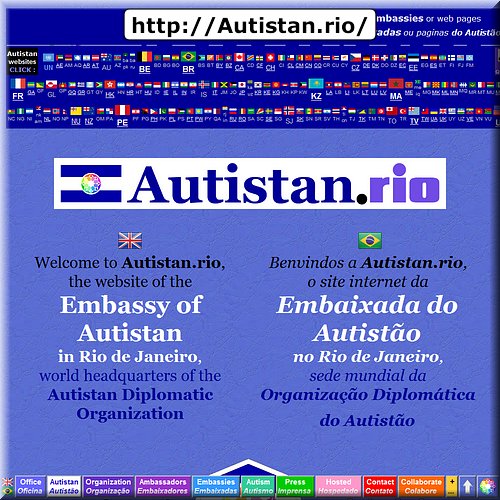
World Administrative Headquarters
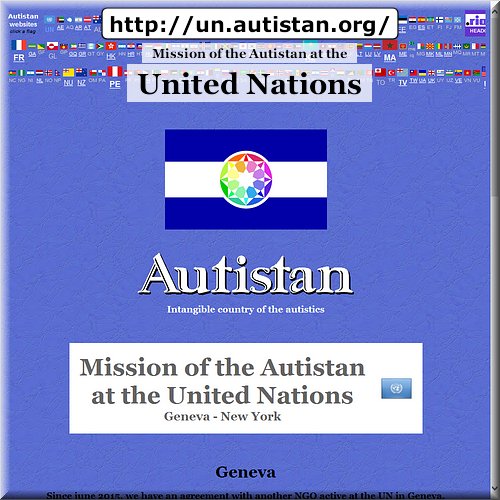
- United Nations / Statutory Headquarters
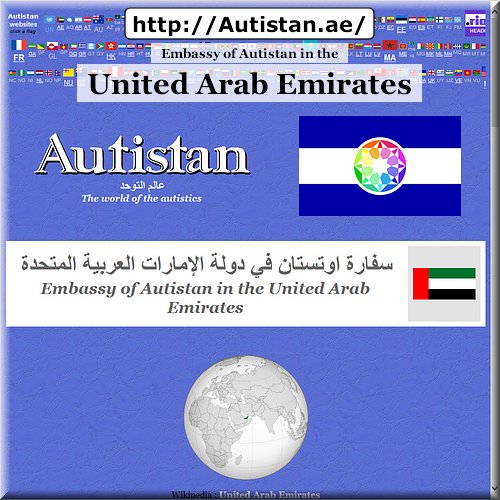
- United Arab Emirates
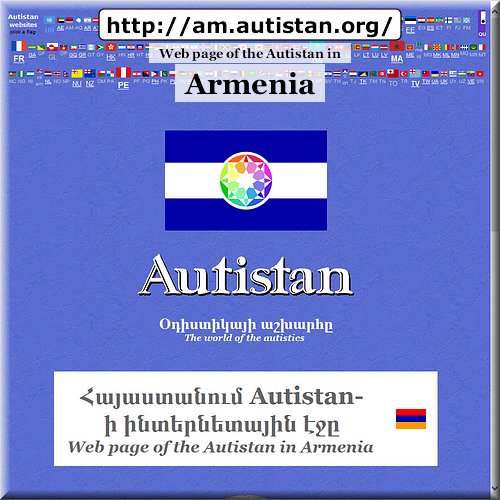
Armenia
- Antarctic
- Argentine
- Austria
- Australia
- Azerbaijan
- Baloutchistan
- Bachkortostan
- Belgium
- Bangladesh
- Bulgaria
- Bolivia
- Brazil
- Bahamas
- Bhutan
- Belarus

- Belize
- Canada
- Congo
- Central African Republic
- Suisse
- Ivory Coast
- Chili
- Cameroon
- Chine
- Colombia
- Costa Rica
- Cuba
- Chypre
- Czech Republic
- Denmark
- Dominican Republic
- Algeria
- Ecuador
- Estonia
- Egypt
- Spain
- Ethiopia

- Finland
- Fiji
- Federated States of Micronesia
- France
- Gabon
- Guyana
- Greenland
- Guadeloupe
- Equatorial Guinea
- Greece
- Guatemala
- Guyana
- Honduras
- Croatia (Croatia)
- Haiti
- Hungary
- Indonesia
- Ireland

- Israel
- Inde
- Iran
- Iceland
- Italia
- Jamaica
- Jordan
- Japan
- Karakalpakstan
- South Korea
- Kenya
- Kyrgyzstan
- Cambodia
- North Korea
- Kuwait
- Kazakhstan
- Laos

- Lebanon
- Liechtenstein
- Sri Lanka
- Lithuania
- Luxembourg
- Latvia
- Morocco
- Montenegro
- Ancient Mesopotamia
- Madagascar
- Republic of Macedonia
- Mali
- Mongolia
- Martinique
- Mauritania
- Maurice
- Mexico
- Malaysia
Nagorno-Karabakh
- New Caledonia
- Nigeria
- Nicaragua
- The Netherlands
- Norway
- Nepal
- Niue
- New Zealand
- Oman
- Panama
- Peru
- French Polynesia
- Papua New Guinea
- Philippines
- Pakistan
- Poland
- Palestine
- Portugal
- Palau
- Paraguay
- Qatar
- Rajasthan
- Russia
- Romania

- Saudi Arabia
- Seychelles
- Suede
- Singapore
- Svalbard and Jan Mayen
- Slovakia
- Senegal
- Suriname
- Salvador
- Thailand
- Tibet
- Tajikistan
- Tokelau
- Turkmenistan
- Tunisia
- Tonga

- Türkiye
- Tuvalu
- Taiwan

- Ukraine
- United Kingdom
- Uruguay
- Uzbekistan
- Vietnam
- Vanuatu
- United States of America
- Samoa
- Mayotte
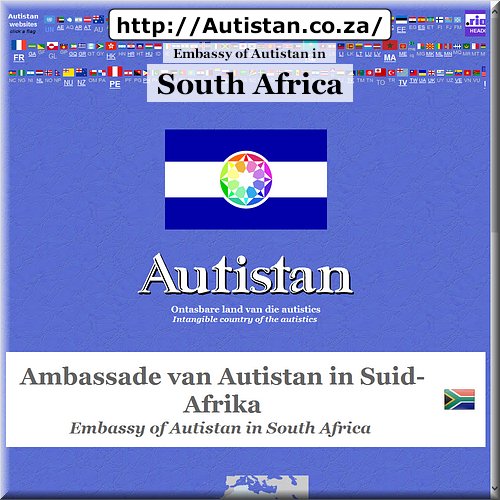
- South Africa
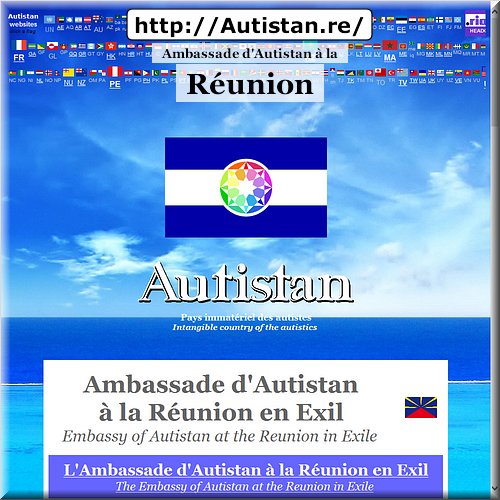
- Meeting
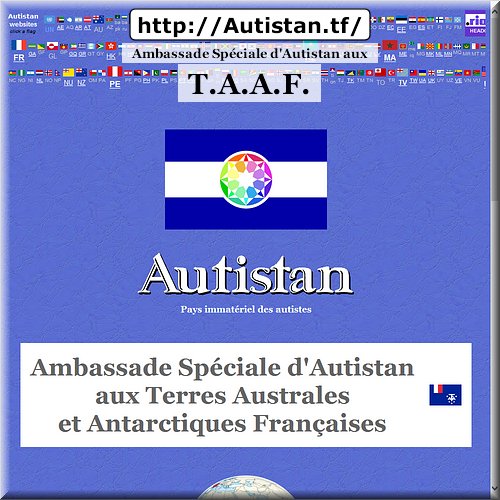
- French southern and Antarctic lands
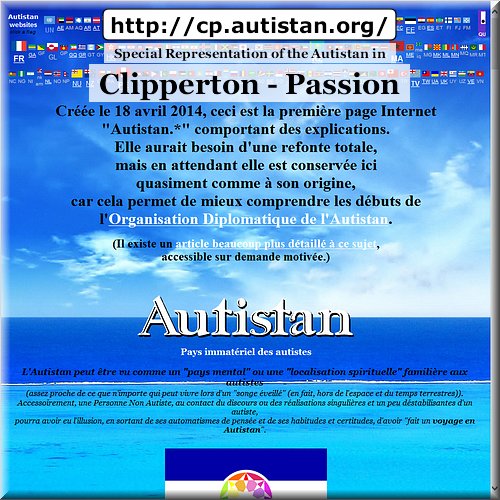
- Clipperton-passion